


Display, in small numbers — a scroll, flowers, an incense burner or a craft object, one to a few pieces at most. It is not a shelf for daily objects or storage, and by custom one neither steps into the alcove nor sits in it.
The Art of TOKONOMA
What Is a Tokonoma? — A Space of Time and Emptiness

The Tokonoma Within the Room
A tokonoma does not stand alone. Traditionally, it works as part of a tea room or a washitsu — a Japanese room.
The stretch of tatami, the light through shoji, the veranda and garden beyond: the alcove takes its meaning from this context, and only within it does the tokonoma fully function.
As the diagram shows, the tokonoma is set at the room's most composed face, and the seat with its back to the alcove is the seat of honor. In the traditional order of hospitality, a guest first approaches the alcove to view the scroll, and only then takes the seat prepared for them. The etiquette of the entire room is anchored in this one corner.
The Anatomy of the Tokonoma
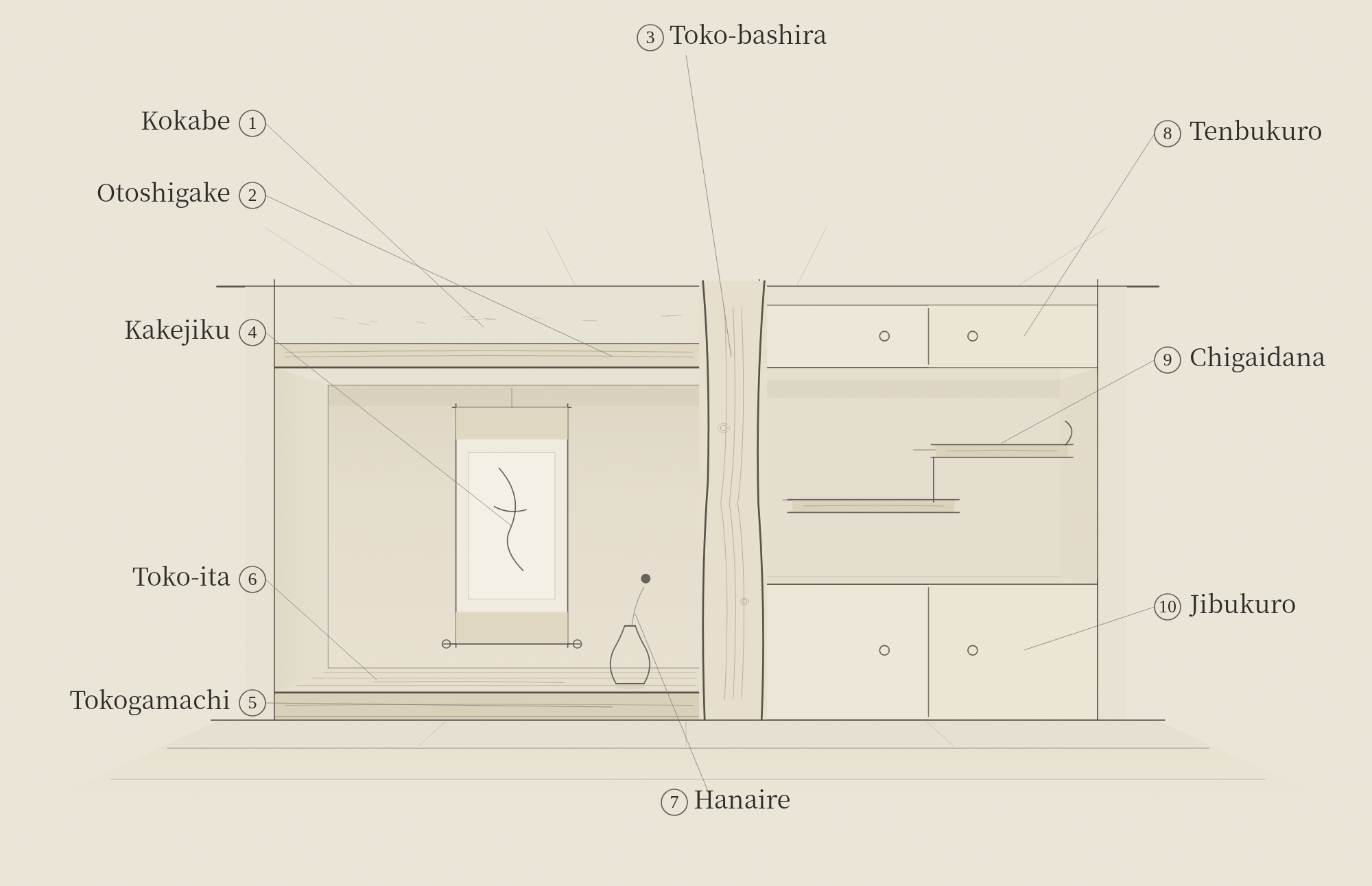
A single tokonoma is made of a number of parts. Once you know the names, you see it differently.
- Kokabe — the small wall above the hanging beam. It sets the height of the opening and frames the alcove's scene like a picture mount.
- Otoshigake — the finished beam across the top of the opening. The alcove's "eyelid."
- Toko-bashira — the display pillar dividing the tokonoma from the side bay. The most carefully chosen piece of wood in the room; polished logs and fine timbers are traditional.
- Kakejiku — the hanging scroll, the alcove's protagonist, changed with the seasons. Traditionally, a scroll of Zen calligraphy hangs here more often than anything else. → See "What Is a Kakemono?" (link after publication)
- Tokogamachi — the finished front edge of the raised floor. The horizontal member nearest a guest's eye.
- Toko-ita — the raised floor itself; boarded, or in some alcoves finished in tatami.
- Hanaire — the flower vessel, placed on the floor or hung on the pillar. One kind of flower, one stem or so, is the classical restraint.
- Tenbukuro — small cabinets at the top of the side bay.
- Chigaidana — the staggered shelves: two boards at different heights, joined by a small post called the ebizuka, the upper shelf finished with a small upturned lip, the fudegaeshi.
- Jibukuro — low cabinets at the base of the side bay.
The side bay beside it — the tokowaki — is the stillness set against the alcove's motion. The tradition of alcove, shelves and study bay composed as one set, the zashiki-kazari, comes from shoin-zukuri, the formal residential architecture that developed in the Muromachi period.

What Is a Tokonoma For? — Its Spirit
The tokonoma is a space of time and emptiness.
Not storage. Not passage. Not a place to sit. The tokonoma is the one space in the house set apart from utility. And precisely because of that, the single scroll hanging there, the one flower, the incense burning — each speaks the theme of that day, that season, with nothing to dilute it.
In a modern home, every surface is working. Shelves hold things; walls hold switches and screens. Some of it is function, some of it is taste. Against all of that, what the tokonoma teaches is this: emptiness in a home is not space left over. It is something you design, on purpose.
It is the answer the Japanese home has spent a thousand years refining — that, at least, is how we see it.
The discipline of placing one thing only. The sense of time in changing a scroll with the seasons, in setting a single stem. The quiet way it turns us toward the value of what is open, of what is absent.
Translating the Tokonoma — Five Patterns for a Modern Home
Take the essence of the tokonoma to be time and emptiness. If that is what it is, you do not need a Japanese room to have one.
For anyone living inside today's digital noise, anywhere in the world, the tokonoma offers a way to feel the value of time and emptiness — and we think it travels well. We would be glad if you tried it in your own home.
Three principles run through every pattern:
Place one thing. Leave space around it. Change it with the seasons.
We keep a running curation of real examples on wanova's Pinterest boards.

1. The Floating Alcove
A wall niche whose base board floats free of the wall, with concealed lighting beneath. The tokogamachi's "one step up," translated into a modern detail. Of the five, we think it is the most faithful evolution of the original.
It involves interior work, so it suits new builds and renovations. The base board is what matters. A single slab of solid wood gives the whole composition its weight.
At wanova we can also look for materials with a particular spirit — among them miyama-sugi, cedar grown in the sacred forest of Ise Jingu.

2. The One-Scroll Wall
No construction at all. Choose one wall, keep it empty, and make it the fixed place of a hanging scroll — or of a single painting.
Nothing else nearby. A change of scroll a few times a year. That alone makes the wall a modern tokonoma.

3. The Niche Tokonoma
A small recess that uses the depth of the wall itself. Even at 20–30 cm deep, it will hold a single-stem vase and a small vessel with their space around them.
It is the most practical pattern for an apartment renovation. Light it with one lamp from above, and let the object cast a shadow.

4. The Mantel Mitate
Treating a console table or a mantelpiece as a tokonoma.
Mitate — seeing one thing through the form of another — sits at the heart of the Japanese eye. This pattern begins today. All it asks is that you change what you choose to put there.
One condition: a single object, changed with the seasons. Bringing time and emptiness into daily life is the point of the exercise.

5. The Entryway Toko
The smallest tokonoma in the house — the display shelf at your entrance.
It is the spot your eye meets at every homecoming and every guest's arrival. Which is exactly why one seasonal object works so hard there.

And for Those Who Want the Real Thing — A Bespoke Japanese Space
The five patterns above are all things you can begin yourself, today.
But some readers are looking past them — to the case where what you want is the real thing: a true tokonoma, a tea room, a Japanese space made in Japan, realized in a country that is not Japan. Japan itself, outside Japan. We understand how much that matters to those who insist on the authentic.
wanova builds full washitsu and tea rooms overseas, working with Japanese architects and craftsmen steeped in the tradition. A single toko-bashira pillar, the earth for the walls, the igusa rush for the tatami — materials are selected in Japan, and we carry the work from design through construction to the final placement of the one piece displayed. From concept to completion, in Japan and abroad.
If this speaks to you, we would be glad to hear from you.

A Short History of the Tokonoma
The tokonoma's earliest ancestor is thought to be a display place set before a Buddhist image, with a censer, a candlestick and a flower vase arranged in front of it (theories vary).
In the Muromachi period, shoin-zukuri architecture fixed the alcove, shelves and study bay as one formal set. The tea ceremony then refined that spirit towards simplicity, and in time the alcove spread into ordinary homes.
Today, as Japanese rooms themselves grow scarce amid the globalization and standardization of housing, the tokonoma is being quietly revalued, in Japan and abroad, as emptiness with a center.

The Tokonoma in Tea and Zen
The first thing a guest does on entering a tea gathering is not to take a seat. It is to go to the alcove and view the scroll — because a single line of Zen calligraphy quietly announces the theme of the whole gathering.
Flowers as they stand in the field. The scroll a half-step ahead of the season. In the way of tea, you could say the tokonoma is the spiritual center itself.
TOKONOMA FAQs
What belongs in a tokonoma — and what doesn't?
What are the typical dimensions of a tokonoma?
Traditionally around one ken wide (about 1.8 m) and half a ken deep (about 0.9 m). But half-width alcoves are long established, and modern niche versions can be far smaller.
Are there rules about where a tokonoma should face?
It is placed at the room's most composed face, ideally visible from the entrance. Regional and school conventions differ, and there is no single strict answer. In a new build, light and circulation decide it in practice.
Can I live with a tokonoma without having one?
Yes. Keep one wall empty, display one thing, change it with the seasons. That is the tokonoma's essence.
Worldwide projects
For a true Tokonoma, built in Japan and installed where you live


©︎ WANOVA / SATOYAMA Marketing Office Ltd.
Roppongi, TOKYO