

Because mat sizes differ by region. Kyoma, centered on Kansai, is about 191 × 95.5 cm; Edoma, centered on Kanto, about 176 × 88 cm; Chukyoma sits between them. Smaller sizes exist for apartment buildings. The same "six mats" can mean different floor areas. In property advertising, one mat is converted at 1.62 square metres or more.
The Art of SHOJI
What Is Tatami ? — Tatami is furniture you walk on.

The Definition
A tatami is a floor mat: a woven facing of igusa rush stretched over a thick core and bound at the edges with cloth.
What sets it apart is that you sit and sleep directly on it. A floor meant for chairs and beds carries a narrower job. In a tatami room, the floor is itself the place you sit, and the place you lie down.
So a tatami is a floor and, at the same time, a piece of furniture. That is one reason the Japanese house managed for so long with so little furniture in it.

Context — How Mats Are Laid
A tatami is not a rug you set down on its own. It is one part of a single surface, planned to the dimensions of the room. Which is why a Japanese room is described first by how many mats it holds.
There is a manner to the laying. In an ordinary house the mats are set so that the joints never cross in a four-way. A layout where four corners meet at one point is understood to belong to temples and to funerals, and has been avoided in everyday rooms. The names for these layouts, and how strictly they are kept, differ by region and by school.
And the borders draw lines across the room. Where to sit, where to walk. That a room with no furniture in it still tells you where to settle — that comes, I think, from these lines.
The Anatomy of the Tatami
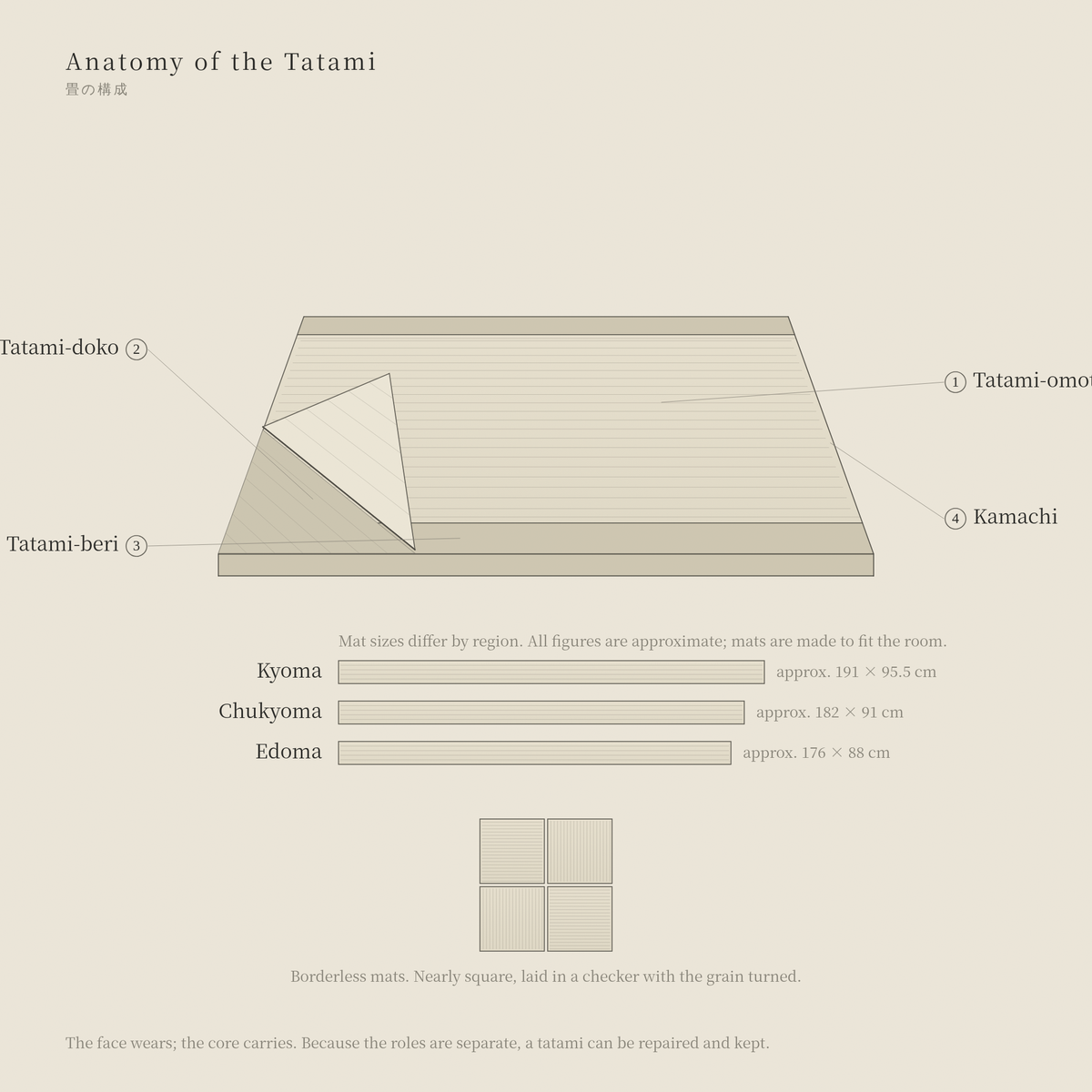
A single tatami is made of a number of parts. Once you know the names, you see it differently.
- Tatami-omote — the woven rush facing. The surface you touch, and the first part to wear
- Tatami-doko — the thick core. Traditionally compressed rice straw; today also wood fiberboard or foam
- Tatami-beri — the cloth binding the long edges. It protects the mat and draws the room's lines. It once declared the rank of whoever sat there (see the history below)
- Kamachi — the short end, left without cloth
Mat sizes differ by region. Kyoma, centered on the Kansai area, is about 191 × 95.5 cm; Chukyoma about 182 × 91 cm; Edoma, centered on the Kanto area, about 176 × 88 cm. Smaller sizes exist for apartment buildings. All of these are approximate: in practice each mat is made to fit its room. That is why "six mats" is not one fixed area.
Some mats are made without a border, nearly square, and laid in a checker with the grain turned. They are widely called "Ryukyu tatami", though the original Ryukyu tatami means a mat woven from shichitoi, a different rush. The name is used loosely.

Why was tatami made, and how did it become the floor of the Japanese house?
Tatami is furniture you walk on.
Because people sat on the floor and slept on the floor, and the floor took that on. If you live with chairs and a bed, the floor may as well be hard. If you spend your time directly on it, it needs other properties. Enough give. Comfort under a bare foot. The ability to take up moisture and let it go again. Rush and straw met those conditions.
Lay a mat and the place becomes a sitting room, a bedroom, a guest room. Rather than fixing the use with furniture, the floor absorbs it. That is how one room could change its role through the day. The adaptability of the Japanese house comes from this floor.
And a tatami is built on the assumption that it will wear. Only the face goes. Turning the facing, replacing the facing, rebuilding the mat — there is a repair for each stage of wear. Its strength is not that it will not break, but that it is meant to be mended.
Today — Four Ways to Use One
Soft underfoot, good on bare skin, and something you can sit on directly. Take those properties and tatami translates into a contemporary interior. All you need is a piece of floor and the wish to spend some time low down.
Three principles run through every pattern:
Walk on it barefoot. Sit low. When it wears, change the face.
We keep a running curation of real examples on wanova's Pinterest boards.

1 The Tatami Corner (no building work)
This one you can begin today, with no work at all. Set a few oki-datami — loose mats — into one corner of a wooden floor. Two make a place to sit; four make room to lie down.
What matters is pushing them properly into the corner. Floated halfway out, they read as a rug. Run them along two walls and the spot stands up as a place of its own.
Where it works: a corner of a living room, a play area, a rented flat
Watch for: over underfloor heating, choose mats made for it

2. The Raised Room
Build the tatami surface one step above the floor. The act of stepping up is enough to make it another place. It gives you an edge to perch on, which makes it an easy pattern for anyone not used to sitting on the floor.
The step can hold drawers. Given how rarely a tatami room comes with storage, that is a distinctly modern answer.
Where it works: a corner of an open-plan room, a window bay, spaces with high ceilings
Watch for: a step of around 35–40 cm sits well when you perch on it

3. The Tatami Bed
Make the top of the bed a tatami surface. You can leave the mattress out and lay a futon directly on it.
Sleeping on tatami, the body does not sink in. Neither hard nor yielding, it is a different feeling from a mattress. Lift the futon in the morning and the surface is a floor again.
Where it works: bedrooms, studio apartments, guest rooms
Watch for: choose a construction that lets air move underneath

4. The Single Nap (no building work)
Put one loose mat by a window. Not two, not four. One.
It is not a place to sleep, and not a place to sit. It is one mat for getting down onto the floor. The quickest way to learn what living with tatami is like is to put one down and take a nap on it.
Where it works: by a window, at the foot of a desk, when you want to try it first
Watch for: a sunlit spot will bleach the facing faster. Choose it depending on whether you can call that character

And for Those Who Want the Real Thing — A Bespoke Japanese Space
The patterns above are all things you can begin yourself, today.
But some readers are looking past them — to the case where what you want is the real thing: true tatami, a Japanese space made in Japan, realized in a country that is not Japan. Japan itself, outside Japan. We understand how much that matters to those who insist on the authentic.
wanova builds full washitsu and tea rooms overseas, working with Japanese architects and craftsmen steeped in the tradition. A single toko-bashira pillar, the earth for the walls, the igusa rush for the tatami — materials are selected in Japan, and we carry the work from design through construction to the final placement of the one piece displayed. From concept to completion, in Japan and abroad.
If this speaks to you, we would be glad to hear from you.

A Short History of the Tatami
Yusoku-datami — When the Border Named the Sitter
Tatami did not begin as something laid wall to wall. It was a seat, set down on a boarded floor wherever one was needed — what we would now call oki-datami, a loose mat. That the word tatami connects to tatamu, to fold, is said to come from its having been something you folded away (accounts vary).
Because it was set down one mat at a time, each mat was bound up with the question of who would sit on it. The yusoku-datami — the ceremonial tatami of the court, of temples and of shrines — carries that usage into the present.
The clearest sign of it is the border. The patterns run in an order of rank: the ungen-beri, held to be the highest, was used for the seats of the Emperor and Empress and for the seats of Buddhist images; below it the korai-beri, for princes and senior courtiers (periods and sources differ). The bright border under the Emperor and Empress dolls of the Doll Festival is an ungen-beri.
So the border of a tatami was a sign of rank before it was an ornament. It is the surest evidence I know that a tatami was a seat before it was a floor. That work is carried on today by the craftsmen who make the tatami of the court, of temples and of shrines.

Wall to Wall
Laying mats across the whole floor is generally placed with shoin-zukuri, from the Muromachi period. Once the floor was filled with tatami, a room's size came to be measured in mats, and an order appeared in where one sat.
By the Edo period tatami had spread through townhouses and farmhouses and become the standard floor of the Japanese home. With it, the trade of making and repairing mats took root region by region.
Today, as rooms went western, tatami rooms themselves grew fewer. Even so, in the form of loose mats and raised platforms, a place to sit low down has been coming back into the house.

In the Culture
What tatami has supported is a culture of bare feet and of sitting.
A Japanese house begins with taking your shoes off at the entrance. Because you step onto the floor barefoot, the feel of the floor has decided the quality of daily life directly. The slight give and return underfoot. Cool under the sole in summer, not cold in winter. These are hard properties to put a number to, and the clearest thing about them is what you notice once you live with it.
And the posture of sitting on the floor has shaped the relations inside a house. The upper seat and the lower, where a guest sits, where the host sits. In the way of tea, the position of a utensil may even be counted in weaves of the mat — though the fine points of that differ by school.
A new mat is green, and it carries a scent. With time the color fades and turns amber. Without moving from the room, the floor tells you the season and the years. There are not many floor materials that do that.
TATAMI FAQs
Why is "six mats" not always the same size?
I am worried about mites and mould.
The basics are drying and moving air. Vacuum often; open the windows on a fine day. Do not leave a futon down on the mats. Keep the humidity in check. Those four prevent most of it. If something has already appeared, or if you suspect damp coming up from below, speak to a tatami maker.
What is the difference between uragaeshi, omotegae and shincho?
Uragaeshi is turning the facing over to use its back. Omotegae is renewing the facing and the border while keeping the core. Shincho is building the mat again from the core. They answer wear at increasing depth. How soon each is due varies so much with use and setting that the reliable answer is to have a tatami maker look.
Can I put a chair or a bed on tatami?
You can. But narrow feet will dent the facing. Put a board or a purpose-made cup under each foot to spread the load. Castor chairs wear tatami quickly.
Worldwide projects
For a true Tatami, built in Japan and installed where you live


©︎ WANOVA / SATOYAMA Marketing Office Ltd.
Roppongi, TOKYO